The Complete Handbook of Bicycle Cranks
A practical reference for mechanics, retailers, builders, and riders who need to specify, install, and maintain bicycle cranks with confidence.
★★★★★3.7 · 7 reviewsby Alumigogo Books
non-fiction
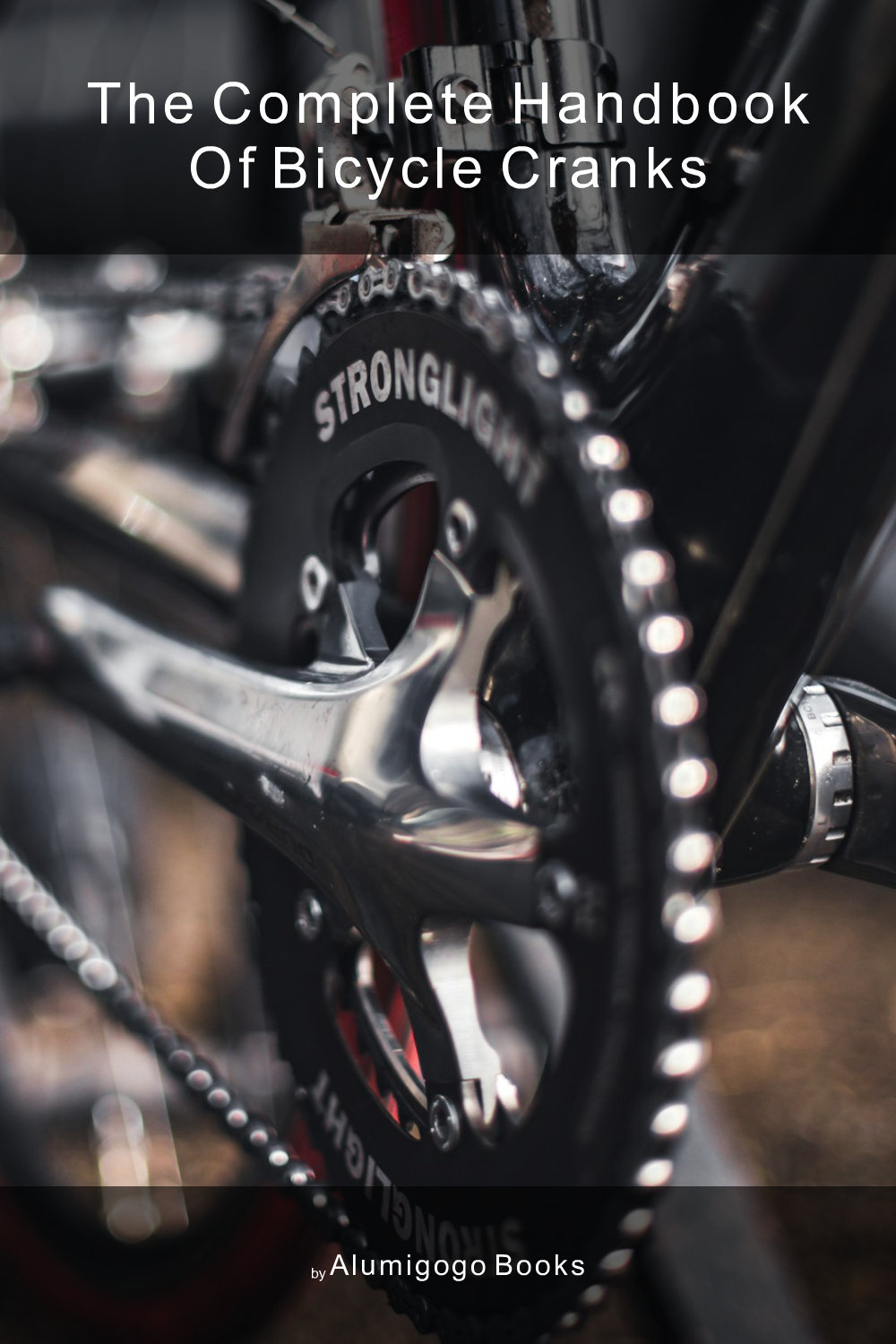
The Complete Handbook of Bicycle Cranks
A practical reference for mechanics, retailers, builders, and riders who need to specify, install, and maintain bicycle cranks with confidence.
★★★★★3.7 · 7 reviewsby Alumigogo Books
non-fiction
Engineering-neutral, field-tested knowledge for specifying, installing, and maintaining every common bicycle crank standard.
🔒Secure checkout via Stripe
Labor Day Sale
$9
About this book
The crank is the single most stressed interface between your legs and the road, yet most riders and many mechanics treat it as a mystery part that just needs a bolt and a torque wrench. This handbook strips away the marketing and gives you the mechanics: how pedal force flows through the arms, how the axle or spindle actually transfers torque to the bottom bracket bearings, and why a 1mm misalignment can lead to a creak that takes months to diagnose.
Written for people who work with cranks professionally or fix their own bikes properly, the book starts with fundamentals and moves through every common standard. You will learn the differences between square taper, splined interfaces, and direct-mount designs, and why the spindle diameter and bearing position matter more than the number of bolt holes. It includes step-by-step installation procedures with torque values, thread direction notes, and the tell-tale symptoms of a crank installed incorrectly. A full troubleshooting chapter covers creaks, wobble, crank arm extraction, and spindle wear, with concrete diagnostic sequences.
The second half of the book turns to the commercial side: how to evaluate brands and suppliers, what a shop should stock, how to offer crank servicing or installation as a revenue stream, and what to know before private-labeling a crank. The final chapters cover emerging standards like power meter cranks and spindle-integrated electronics, plus the standards bodies and industry publications that serious readers should track to stay current.
Reader Reviews
Amy Hall
★★★★★It's a solid reference and I appreciate the lack of hype. The chapter on installation procedures saved me from putting my new cranks on wrong, so that alone was worth the cover price. But I felt like some sections were a bit heavy on torque specs and light on the actual riding feel differences between standards. The book is careful to stay neutral, which I respect, but it sometimes reads a little like a repair manual and less like the full picture I'd hoped for. Still, a useful shelf book for anyone who works on bikes seriously.
Robert Rodriguez
★★★★★I bought this because I run a small shop and I'm tired of customers asking questions I can only half-answer about cranks. This gives me the language to explain the difference between a square taper and a splined interface without stalling. The troubleshooting chapter is genuinely useful; I followed the creak diagnosis flowchart and found a worn spindle cup on a customer's bike. My one complaint is that the business opportunities chapter felt a little padded, and the installation chapter assumes you already have a full toolbox. But for the technical content alone, it earns its place.
Timothy Wilson
★★★★★I've bought a few cranksets in the past based on weight alone, and I've paid for it with headaches. This book finally explained why a cheap crank with a worn taper arm can feel like a slipping pedal, and how a quality spline interface with a preload cap fixes that. I actually read the whole chapter on installation before I put my first Hollowtech II crank on, and it went perfectly. Minor gripe: some torque specs overlap with manufacturer manuals I already had, but having them all in one place is still convenient. The glossary and the FAQ in the back are worth a lot too.
Donna Miller
★★★★★I'm a bicycle mechanic at an independent shop, and I've had to correct at least three installations from other shops that clearly didn't understand bottom bracket spindle pinch bolts. This book made me feel like a professor every time I see that mistake now. The engineering grounding is real — it doesn't just say 'torque to 14 Nm', it explains the clamping forces and the thread direction reasoning. It's a bit academic for the casual rider, but for a working mechanic it's the clearest reference I've used. I only wish it had more photos, since some of the written instructions are dense.
Robert Carter
★★★★★Honestly the most explanatory crank reference I've come across. It explained why my off-brand 30mm spindle crank had more creak than my friend's Shimano, without trashing the off-brand. I appreciated that it discussed both the pros and cons of each standard without acting like one is better. The chapter on choosing cranks walked through realistic scenarios (fixed gear, touring, MTB) that matched my own projects. Lost one star only because it skimps on the history and legacy standards — I'm still figuring out what to do with the old triples lying in my parts bin.
Paul Carter
★★★★★Sound, thorough, and admirably non-biased, but it's not a book for the average rider — I'd say it's aimed squarely at mechanics. I'm a fast recreational rider and I found the first half heavy, but the installation chapter really is meticulous. The checklist for spindle extraction was worth the money, because I definitely mangled a crank once doing it wrong. It did get a little repetitive with the warnings about carbon spindle cranks, and the author, while thorough, tends to repeat torque values. I'll keep it as a manual but I wouldn't call it leisure reading.
John Wilson
★★★★★I run a cycling workshop and I've stopped looking at — wait, this is the book I've been looking for. The chapter on how torque actually transfers through the crank and into the bottom bracket changed the way I train new interns. We've already had them read the installation chapter before touching an actual bike, and we've had zero crank related rework since. The most valuable part for me was the business positioning: it helped me decide which brands to stock for the workshop without just guessing. Not just a handbook — it's foundational for anyone in the trade.