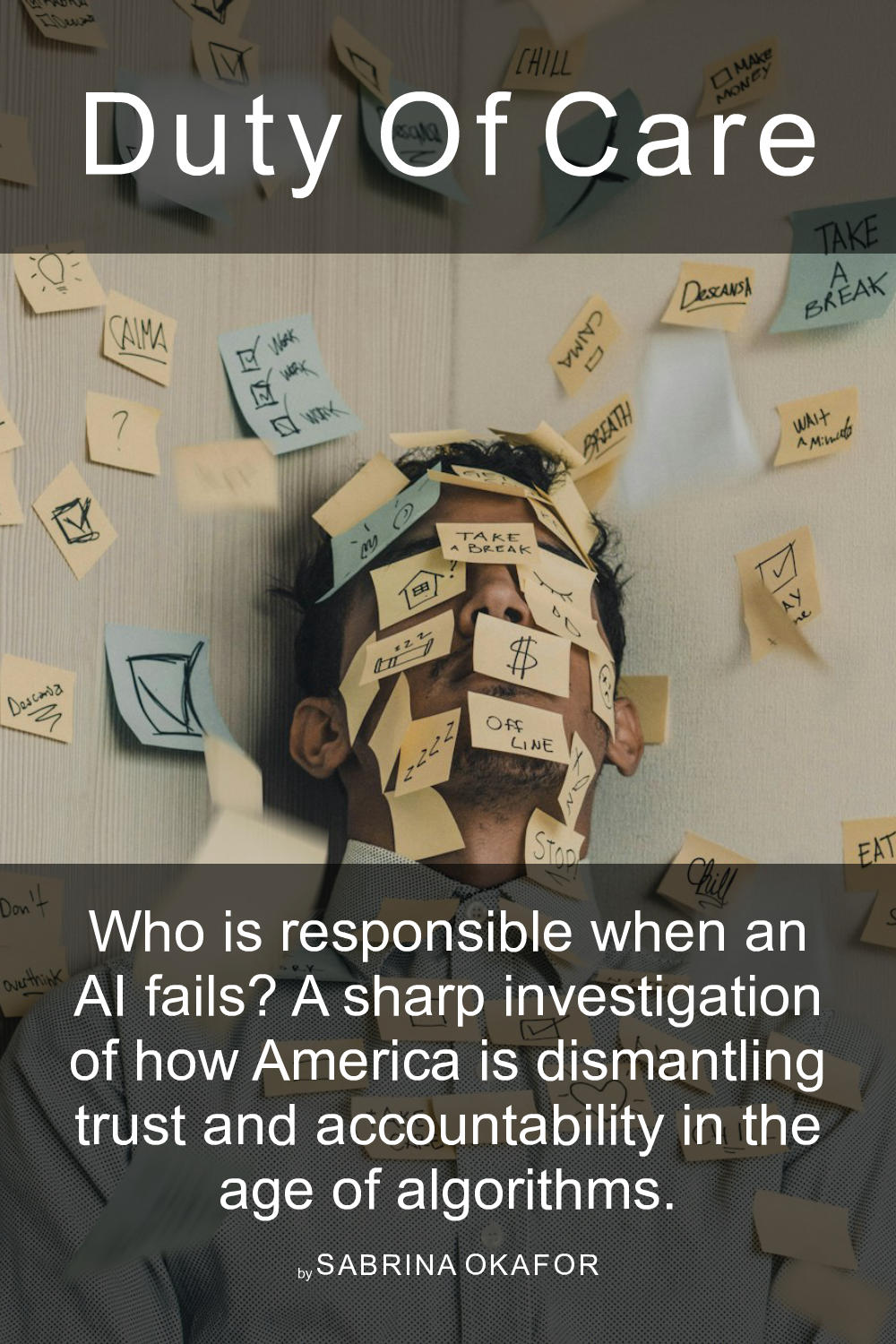
Who is responsible when an AI fails? A sharp investigation of how America is dismantling trust and accountability in the age of algorithms.
🔒Secure checkout via Stripe
Labor Day Sale
$9
About this book
Lawmakers propose a kill switch for AI. Hospitals hand over patient triage to chatbots. The Pentagon funds a billion-dollar science initiative driven by machine intelligence. Duty of Care is a narrative non-fiction book that examines this moment not as a technological revolution, but as a governance crisis—a slow, deliberate dismantling of the chains of responsibility that have held our institutions together for a century.
From the boardrooms of Anthropic and OpenAI to the emergency operations centers of FEMA, the book follows the people writing the new rules of accountability: the executives promising 'alignment,' the whistleblowers who see the cracks, and the regulators scrambling to build a safety net with duct tape and wire cutters. It reveals how each new deployment—from AI medical assistants to automated traffic enforcement—erodes a piece of the social contract, replacing human judgment with algorithmic output that no one fully understands and no one will fully own.
Drawing on exclusive interviews and documents that show the deals and trade-offs behind AI's civic debut, Duty of Care offers no easy villain or hero. Instead, it paints a chilling picture of a country that has pushed autonomy onto its machines without first deciding who is redeemed when things go wrong. A must-read for anyone who has ever asked an assistant to reschedule a meeting, trusted a chatbot with a symptom, or wondered why their probation risk score seemed to know them better than their own lawyer.
Reader Reviews
Kevin Jackson
★★★★★The opening chapter on the 'kill switch' is a great hook, but the book spends a lot of time on process and not enough on the human stories. I wanted more from the whistleblowers and less from the policy minutiae. It's a solid read for policy wonks, but I found my attention drifting in the middle.
Susan Green
★★★★★This is the book I've been waiting for. It cuts through the tech hype and gets to the real issue: nobody is actually accountable when AI fails. The scene in the Rayburn hearing room is painfully accurate, and the insight into how the 'kill switch' is just a bureaucratic gesture is chilling. Essential reading for anyone who cares about democracy.
Amanda Hernandez
★★★★★I couldn't put it down. The way it traces how AI is quietly taking over hospitals, courts, and traffic systems—and how no one owns the consequences—is both terrifying and eye-opening. The interviews with the people inside these systems feel raw and real. This should be required reading for every voter.
Kenneth Martinez
★★★★★There's a lot of good reporting here, but it often reads like a policy brief rather than a narrative. The chapter on the kill switch is a great example—it makes its point but then drags through the committee testimony. I appreciated the depth, but I wish it had been more engaging. Still, worth a read if you're in the field.
Barbara Scott
★★★★★This book is a wake-up call. As someone who works in healthcare, the sections on triage chatbots and medical AI made my blood run cold. The author doesn't just point fingers—they show how the system is being dismantled from within. I've already recommended it to all my colleagues. A masterpiece of investigative journalism.
Lisa Clark
★★★★★I appreciate the thorough research and the serious subject matter, but the writing style is a bit dry in places. The opening hearing scene is vivid, but some chapters feel repetitive—making the same point about accountability over and over. I'd still recommend it to people who want to understand AI governance, but it's not a page-turner.
Timothy Jones
★★★★★Finally, a book that treats AI as a governance issue, not a tech fairy tale. The detail on the 'kill switch' hearing is devastating—it exposes how lawmakers perform seriousness while doing nothing. The stories of the people inside FEMA and the Pentagon are unforgettable. This is nonfiction that reads like a thriller, except it's all too real.
Linda Harris
★★★★★The premise is excellent and the research is impressive, but I found the narrative jumps around too much. One minute we're in a congressional hearing, the next in an emergency operations center, and I sometimes lost the thread. I still learned a lot, but I wished for more focus on a few key stories rather than so many threads.