Buried Futures
How the New Land Barons Are Buying Control of Tomorrow
★★★★★3.5 · 6 reviewsby Rebecca Stern
non-fiction
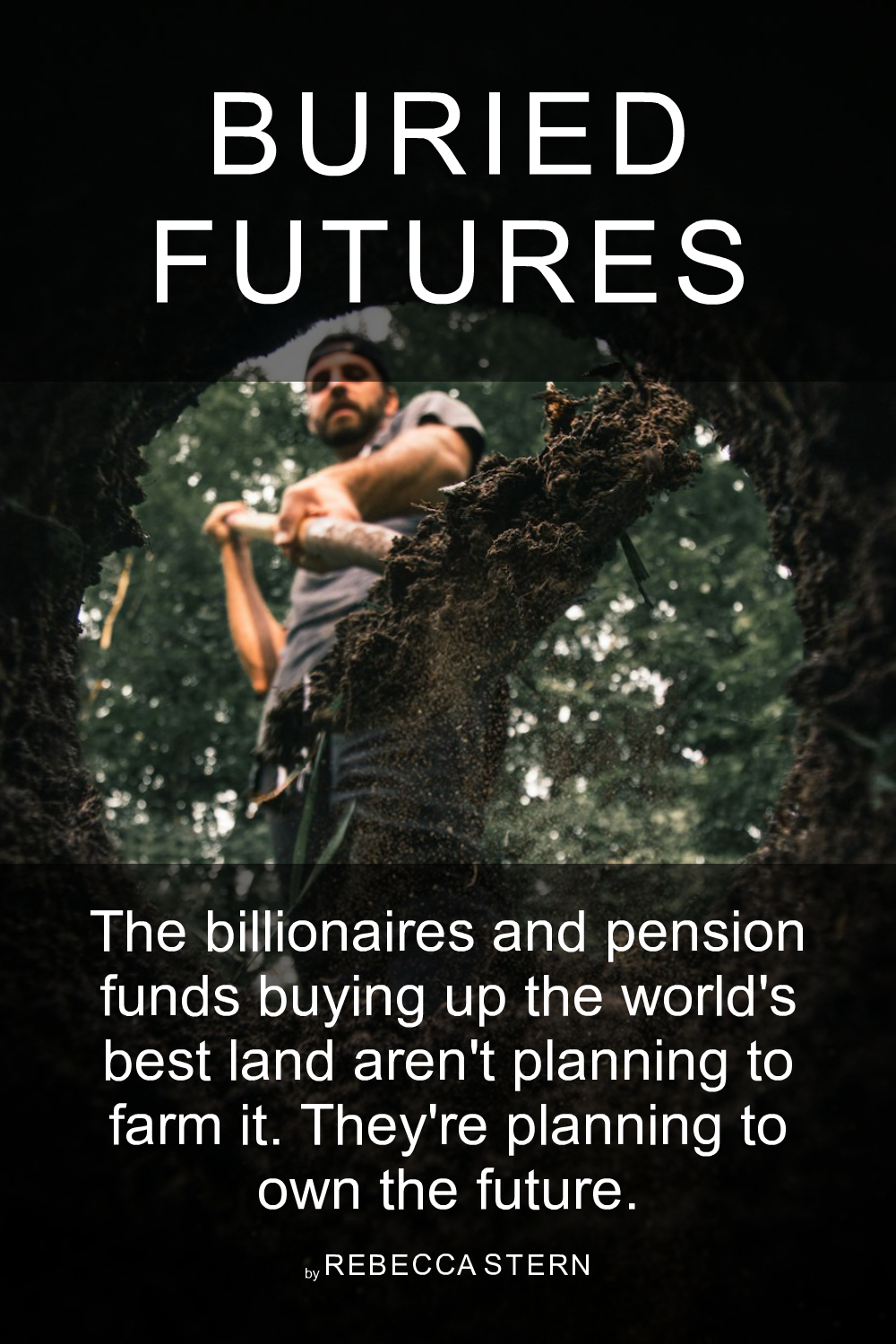
Buried Futures
How the New Land Barons Are Buying Control of Tomorrow
★★★★★3.5 · 6 reviewsby Rebecca Stern
non-fiction
The billionaires and pension funds buying up the world's best land aren't planning to farm it. They're planning to own the future.
🔒Secure checkout via Stripe
Fall Festival Sale
$9
About this book
We think of land as something rooted in place—a home, a farm, a forest. But for the first time in history, the world's richest investors are treating it as pure financial capital: a speculative asset to be accumulated, held, and weaponized. Buried Futures follows the money trail across three continents, exposing how billionaires, pension funds, and foreign governments have acquired over 900 million acres since 2000—an area larger than the continental United States—not to grow food, extract resources, or build communities, but to control scarcity itself.
From a Norwegian pension fund's stake in Tanzanian grazing land to a secretive Chinese conglomerate's control of agricultural zones across Southeast Asia, from Bill Gates becoming America's largest farmland owner to Saudi Arabia securing water rights in Ethiopia, the book reveals the hidden architecture of a land grab that is reshaping geopolitics, food security, and the future of democracy. Each acquisition is perfectly legal. Each is engineered through shell companies, captured regulators, and loopholes in national law. And together, they are quietly converting a resource that once defined citizenship, belonging, and human dignity into a financial instrument owned by distant capital.
Buried Futures argues that unless we fundamentally rethink property rights, land sovereignty, and what it means to own the future, we are engineering a world in which billions of people will be tenants on land that their ancestors worked, lived on, and died defending—and the rent will be set by algorithms and quarterly earnings reports.
Reader Reviews
Jessica Garcia
★★★★★The opening chapters about Wanjiru and pre-industrial land concepts are genuinely compelling—the idea that land was once a relationship rather than a commodity really stuck with me. But once the book shifts into mapping out modern acquisitions (Gates, Saudi Arabia, Chinese conglomerates), it starts to feel more like exhaustive reporting than narrative. I wanted more depth on *why* this happened and *how* we fix it, rather than just cataloging each land grab. Solid investigation, but uneven execution.
Anna Lopez
★★★★★This is essential reading for understanding how billionaires and foreign governments are reshaping the world right under our noses. The 900 million acres statistic is staggering, and the author does excellent work tracing the money trail across continents. My only complaint is the book occasionally gets bogged down in technical details about shell companies and regulatory loopholes—I found myself skimming those sections. But the core argument about converting land into a financial instrument is devastating and important.
Michelle Ramirez
★★★★★The historical framing is brilliant—starting with Wanjiru's forced dispossession in 1952 and then showing how that same logic of land-as-commodity has metastasized globally really clarified something for me. The chapters on water rights in Ethiopia and agricultural zones in Southeast Asia are genuinely alarming. If I'm being picky, some of the solutions the author proposes in the final sections feel a bit underdeveloped compared to the problem-diagnosis, but that's a minor issue in an otherwise sharp and necessary book.
James Hill
★★★★★Well-researched and eye-opening. The connection between pre-industrial kinship-based land systems and modern financial abstraction is clever, and the specifics about pension funds, Chinese conglomerates, and Bill Gates' farmland acquisitions make the invisible visible. The writing is accessible without being dumbed down. My one gripe: the book could have benefited from more interviews or voices from people actually living on these acquired lands. Otherwise, a powerful investigation into how democracy and food security are being quietly sold off.
Kevin Thompson
★★★★★I appreciated the ambitious scope and the opening historical context about how land tenure worked before colonialism. But I'm not entirely convinced by the author's framing that this is all coordinated conspiracy versus just... capitalism doing what it does. The book presents massive data (900 million acres!) but sometimes treats correlation as causation. That said, it definitely made me think differently about land ownership and what we're losing. Worth reading, just take some arguments with a grain of salt.
Edward Lopez
★★★★★The Kikuyu farmer opening is haunting and sets up a powerful thesis about land as genealogy versus land as commodity. But the book tries to cover so much ground—literally, across three continents—that it never quite settles into deep analysis of any single case. I wanted less breadth and more depth. The warning about 'billions of people as tenants' and 'rent set by algorithms' is compelling, but the path from here to there could be explained more clearly. Worthwhile, but frustrated by its own scope.