Attention, Machines
How the Race for Human Focus Became the Battle for Our Minds
★★★★★3.6 · 7 reviewsby Rebecca Stern
non-fiction
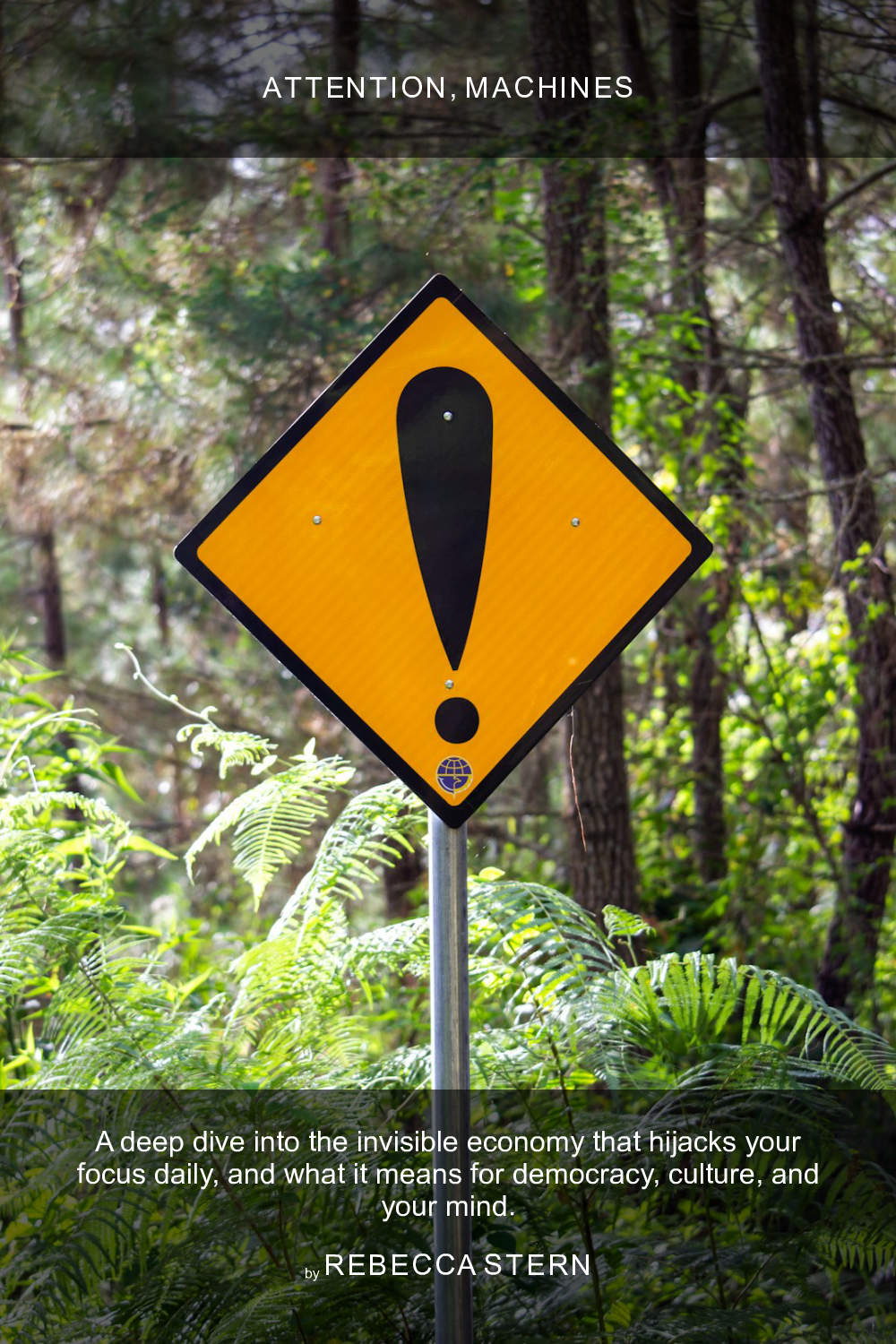
Attention, Machines
How the Race for Human Focus Became the Battle for Our Minds
★★★★★3.6 · 7 reviewsby Rebecca Stern
non-fiction
A deep dive into the invisible economy that hijacks your focus daily, and what it means for democracy, culture, and your mind.
🔒Secure checkout via Stripe
Labor Day Sale
$9
About this book
Every moment, somewhere, a system is learning what makes you scroll, click, and stay. Algorithms are not just shaping what you see online anymore—they are learning to anticipate your needs before you feel them, rewrite your memories in real-time, and speak in your own voice to persuade you. This is not the plot of a dystopian thriller; it is the current trajectory of the attention economy, and it is reaching its ultimate expression with the rise of always-on, personalized AI.
Drawing on the latest developments—from AI-powered assistants that manage your calendar to models that can detect your emotional state from a voice—this book reveals the machinery of attention extraction. It tells the story of how a century of media innovation led to an economy where you are the product, and your focus is the most valuable natural resource on Earth. With vivid case studies and forensic analysis, it shows how 'engagement' has quantified human experience, turning curiosity, anxiety, and even love into measurable metrics that fuel corporate growth.
The book also explores the cultural and political fallout of this extraction, from the collapse of shared attention in public discourse to the rise of new forms of algorithmic power that govern what we know, whom we trust, and even whom we find credible. It argues that our current crisis is not merely about technology but about the very structure of human motivation and freedom. As AI assistants become confidants, students, and even friends, the line between authentic desire and manufactured appetite begins to blur, and the consequences are far more profound than we have yet admitted.
This is a book for anyone who has ever wondered why they check their phone a hundred times a day, and for everyone who worries about the future of human agency. It offers not easy answers, but a necessary map through a landscape that has already been drawn around us. It is an urgent, deeply researched, and accessible analysis of the most important fight we are not having—the fight for our own attention.
Reader Reviews
Margaret Hill
★★★★★The opening about the phone vibration really hooked me, and the chapter on attention as a resource is well argued. But I found the middle sections on AI assistants getting a bit speculative and repetitive. It's a smart read, but I wanted more practical advice and less doom-scrolling through examples.
Susan Harris
★★★★★This book is essential reading. The way it traces the evolution from print to personalized AI and shows how every swipe is a transaction is eye-opening. The bit about the machine speaking in your own voice to persuade you—I couldn't put it down. It's scary, urgent, and brilliantly researched. I've already recommended it to everyone I know.
Edward Williams
★★★★★Interesting thesis, and the opening with the 'invisible weight' is vivid. But it kind of falls into the same trap it critiques—overwhelming you with case studies until you lose the thread. The political fallout chapters were decent, but I felt like it could have been a long article. Still, some sharp observations about phone addiction.
Brenda Jackson
★★★★★I appreciate the alarm bell, and the part about attention being like oil or timber is solid. But as a mom, I kept wishing for more on what to actually do about it. The book describes the problem in excruciating detail, but the 'map' it promises feels more like a tour of the swamp. Dense but not without merit.
Kenneth Taylor
★★★★★A compelling, well-researched look at how our attention is monetized. The opening scene of the phantom vibration is spot on. My only gripe: it could've spent more time on the positive potential of AI rather than just the dystopian side. Still, it changed how I think about my daily screen time—that alone is worth four stars.
Jacob Scott
★★★★★Good writing, but I felt like I'd read half of this in other tech-criticism books. The chapter on emotional detection from voice was the freshest part, but it got buried under repetitive examples of engagement metrics. It's a useful summary of the attention economy, but not exactly a new revelation. Okay for beginners.
Matthew Flores
★★★★★The author makes a strong case that our distraction isn't a personal failure but a designed product. The economics of attention—auctioning off milliseconds—is laid out with powerful detail. I docked one star because the later sections on algorithmic power get a bit academic. Overall, a necessary read for anyone who's ever wondered why they can't put the phone down.